What Defeating the Spartans Can Tell us about AI
As a long-time Ancient History teacher, I have a soft spot for Classical antiquity, especially the lives of the Greeks. It was a time of rapid growth in human accomplishments and the human condition. Greek thinkers made monumental advances in philosophy, mathematics, astronomy, medicine, art, architecture, and government that we still utilize today. I had a college professor years ago who noted that the population of Athens during antiquity was 200,000 to 300,000 people. That’s a lot of people for antiquity, but no different from the city population of Richmond, Virginia today. Nothing against Richmond, one of my favorite cities in the country, but it will never match the technological and cultural impact of Athens or the other city-states of Hellas.
Yet for all the advances in human thought during this time period, it is easy to overlook the constant warfare and instability present in Ancient Greece. We see pretty common narratives of the Greeks as a united front against others (against Troy in the Iliad and during the Persian Wars against Persia), yet the Greek city-states were far more likely to fight amongst themselves. During the Athenian Golden Age of the 5th and 4th Centuries BCE, Athens was more likely to be at war than at peace, and this turmoil among Greek city-states only ended when they were collectively defeated by Philip of Macedon. Athenian, Corinthian, and Ionian Greeks made tremendous advances in the human condition, but could never understand peace.
When we think about Greek warfare, we are likely to think about Sparta. Unlike Athens and other Greek city-states, Sparta had no accomplishments in mathematics, architecture, sculpture, or drama. However, Sparta has many accomplishments in warfare. Spartans trained for war from youth, and full-blooded Spartan citizens (called “Spartiates”) were the most feared warriors in the known world. It was the purpose of the Spartan citizen to excel militarily and to never surrender. A famous Spartan saying was "Ή ταν ή επί τας", which translates to “With your shield or on it”; Spartans were to either return to Sparta victorious holding their shields or die in battle, carried on them by their surviving peers. And Sparta famously thrived as a military power, consistently defeating their enemies. Even when they lost, like at Thermopylae as made famous from the movie 300, they fought bravely to the death and were recognized for their battle prowess. When Spartans did surrender, such as at the Battle of Sphacteria in the Peloponnesian War against Athens and her allies, it was shocking.
For centuries Sparta was the military powerhouse of Ancient Greece. But in one day at the Battle of Leuctra, that logic fell apart; the Spartan army faced a devastating loss to the one of the most innovative Greek military minds of his time, Epaminondas of Thebes.
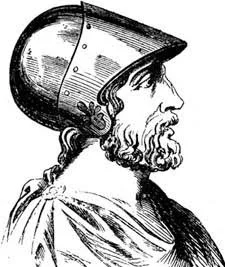
Epaminondas of Thebes
Epaminondas is not as well known as his contemporaries in other Greek city-states (Pericles in Athens, Leonidas in Sparta), perhaps because his home of Thebes was destroyed by Alexander the Great only thirty years after his death. However, those who lived in antiquity thought the world of him: the famed historian Xenophon admired him more than any other Greek leader, and Cicero referred to him as “the first man of Greece.” He displayed the qualities that Greeks held in high regard: he was patriotic, had a strong moral compass, and despite being a very strong student and athlete, remained modest (he was never guilty of hubris!)
Sparta and Thebes had tussled for power for years before Leuctra. Sparta had marched armies to Thebes with the intent to reconquer the city-state, however, Thebes refused to fight them, creating earthworks and walls to keep Sparta out; during that time, Epaminondas and Thebes trained for when the battle would occur. And it did, at Leuctra in 371 BCE. Sparta marched north with 10,000 hoplite infantry, including 700 elite Spartiates, far outnumbering the 6,000 Theban soldiers.
In hoplite warfare, soldiers held their shields with their left hand and their spears with their right hand. However, this could result in the phalanx shifting rightward as soldiers led with their spear over their shield. Thus, for centuries, commanders put their strongest soldiers on the right side of their phalanxes. However, Epaminondas placed his strongest soldiers on the left side of the Theban phalanx, and placed more soldiers on the left flank (a row of fifty rather than a row of twelve), making the row deeper. When the battle commenced, the elite Spartan soldiers faced far more resistance than anticipated.
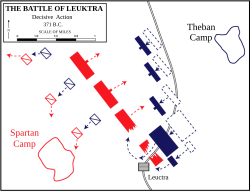
A map of Leuctra, Thebes in blue
The results were catastrophic for Sparta. The right flank quickly fell apart, killing 1,000 men and 400 of their elite Spartiate soldiers (including the King). Other Spartan soldiers, seeing their most elite soldiers struggling and dying, quickly fell apart and retreated. Sparta lost up to 4,000 of their troops, while Thebes lost no more than a few hundred. After the victory, Epaminondas marched to Sparta and freed the helots, whom Sparta had enslaved for hundreds of years. Additionally, Sparta had often maintained allies due to their power and intimidation. They had lost, but they had never been crushed. Finally, Sparta only had so many full-blooded Spartiates, and consistent fighting kept them away from home and away from having children. There were only 800 full Spartiates by the time of Leuctra, and Thebes had killed half of them. Sparta remained a physical city-state, but its aura was gone.
With Sparta severely weakened, Epaminondas led a decade of Theban dominance, where Thebes took the place of Sparta in influencing Greek politics. As a result, nine years later at the Battle of Mantinea, Thebes faced Sparta again with the help of Athens and other city-states looking to weaken Thebes. And once again, Epaminondas and Thebes won and defeated Sparta in the biggest hoplite battle in Greek history. Yet Epaminondas never saw the aftermath of this victory, and died in battle. Twenty years later, Philip of Macedon used Epaminondas’ tactics to defeat a weakened combination of Greek city-states and conquer them.
Epaminondas had thrived because he created a new strategy and solution to a problem that no one else before him considered. Some historians see his decision to put his strongest soldiers on his left flank as a strategic choice, others have noted it could have been a spur-of-the-moment decision to fight off a rapidly approaching enemy. But it changed warfare forever; had he not taken on this strategy, Philip of Macedon could not have followed his ideas, and perhaps Greece resists Macedonian invasion and Philip’s son Alexander never becomes Great.
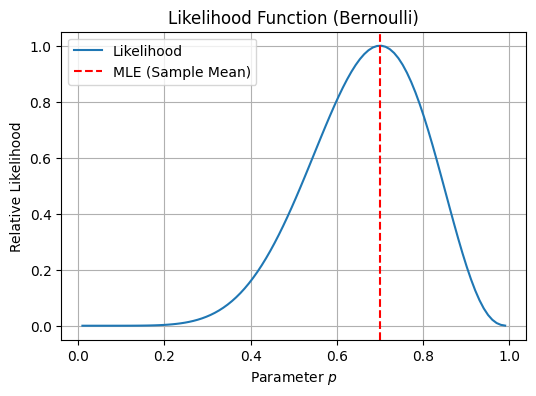
A Bernoulli likelihood function, the foundation of modern LLMs
So what does this have to do with artificial intelligence? And what does this have to do with the need for thinking?
If we look at Large Language Models (LLMs) and other forms of artificial intelligence, they do not have a foundational understanding of human language and understanding. And barring some unforeseen technological advances, they never will. What they are exceptional at is predicting the likelihood of an event taking place. This could include the likelihood of a basketball player scoring X number of points, the likelihood of a patient developing a chronic health condition, and in the case of LLMs, the likelihood that the next word in a sentence sounds like human language. What is striking in the past five years has been the growth in how effective these AI models are in understanding how so many different variables impact the likelihood of an event happening. This includes the likelihood of a basketball player scoring two or three points if they are matched up against a given defender, playing in the 27th minute of a game, and recovering from a sprained ankle, all with 3:02 left in the 3rd quarter. This includes the likelihood of a 40 year old otherwise healthy patient developing breast cancer based on where they live, who their parents are, and thirty other factors that we could not quantify until recently. This includes me asking an LLM what I can make for dinner using the leftover ingredients in my fridge. They consider data and variables, calculate likelihood of events happening, and then produce an answer with the highest likelihood of being correct. This is revolutionary, and has led to significant changes in how we as humans live. Most are for the best! I can get instant feedback on anything my mind desires, and the responses have, given the training data we use, a high likelihood of being right. It still fascinates me that there can be so much variation in the responses; I can ask an LLM a question 10 times, and get variety in the answers that probably are all equally informative.
However, there are drawbacks. One that I have been considering a lot recently is what happens when AI use stops being supportive and starts being dependent. As a basketball coach, I want to utilize the likelihood of a player on my team scoring a basket, but I don’t want to give up trust in my own judgment. It should never replace me knowing my players, knowing strategy, and seeing actions in real time to determine the best action to take. Researchers have called this “cognitive offloading” where while AI helps individuals produce better work, the output of that work becomes homogeneous. In an article in Science, researchers noted that when users were able to use AI to help write stories, they were able to write works that were seen as more creative. However, these stories were not unique and the outputs of AI-assisted or produced work lacked creativity and individualism. In our hope to be right, accurate, or impressive, we are producing work that reads like everything else.
I have worked in education for 20 years as a teacher and administrator, and what I have loved about teaching is helping and seeing people learn. AI tools are wonderful tools to promote learning when the product is based around the likelihood of a correct answer. However, Epaminondas did not think this way; if he had been able to ask ChatGPT what to do to defeat the Spartans, it would have given the rule that had worked best before that: to put the best soldiers on the right. The human condition that thrived in Ancient Greece was to invent new ways to understand the world, and we cannot let a dependence or an overuse of artificial intelligence take that away from us.
I created Data, Purpose, People to maintain the humanity in the world of AI. As a long time educator, I look at this through the lens of education and encouraging us all to maintain what makes us human: our ability to think for ourselves. Emerging AI technology may make it easier for us to check boxes, to fulfill a rubric, and to accomplish tasks, but those are always based around maximizing likelihood to ensure we are as close to an answer as possible. Yet an answer does not always mean the right answer.
Works Cited:
Anil R. Doshi, Oliver P. Hauser, Generative AI enhances individual creativity but reduces the collective diversity of novel content. Sci. Adv, 10.So what does this have to do with the artificial intelligence? And what does this have to do with the need for thinking?
